TPLO (Tibial Plateau Levelling Osteotomy) is a surgery for treating dogs with cranial cruciate ligament rupture of the stifle (knee) joint. We recommend it as the most reliable procedure to restore excellent, near-normal limb function.
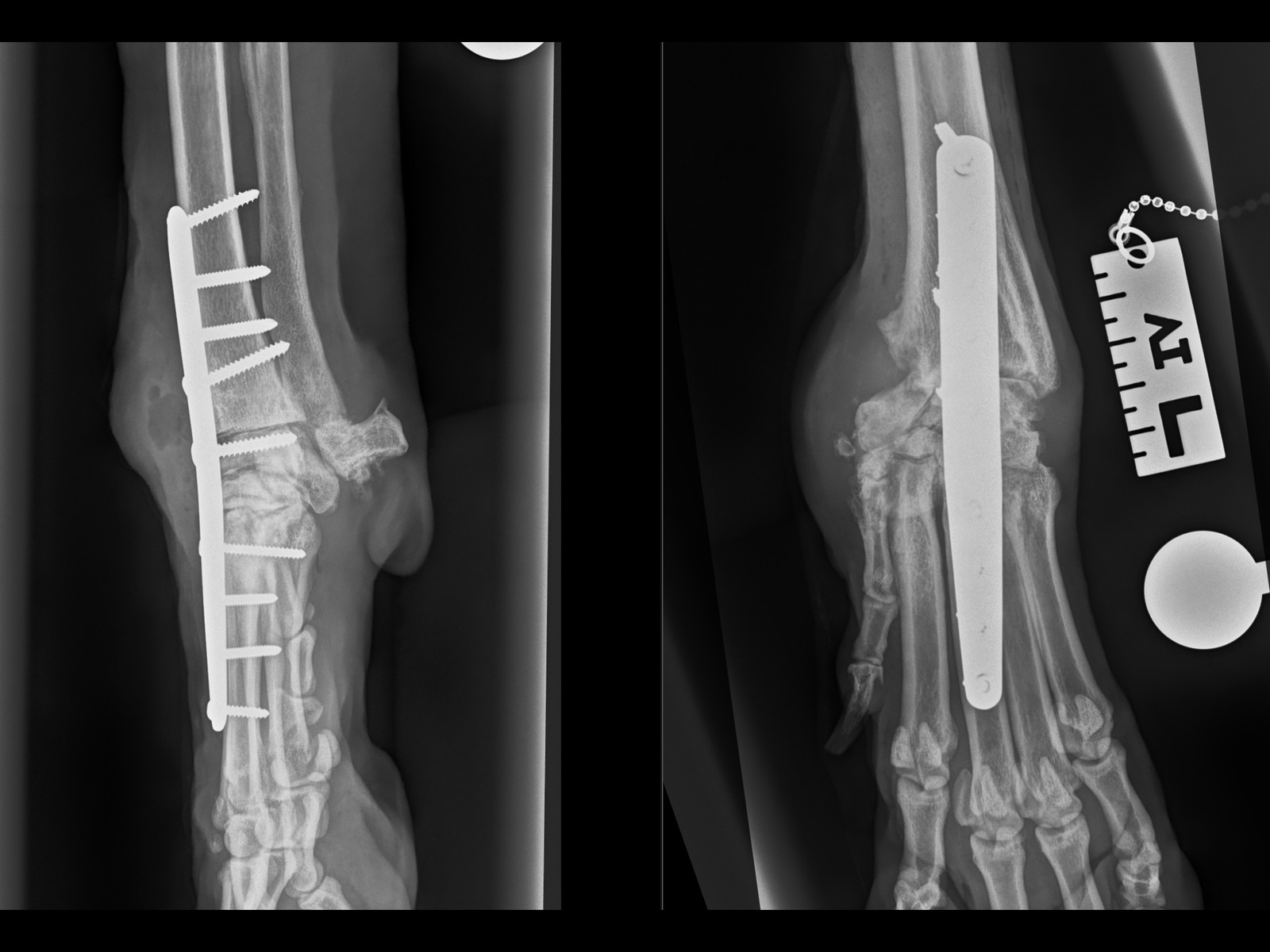
TPLO (Tibial Plateau Levelling Osteotomy) is an operation that changes the shape of the upper part of the tibia bone. A curved cut is made in the tibia, the upper segment of bone is rotated by a calculated amount and fixed in its new position with a TPLO plate +/- small pin. This changes the contact mechanics between the femur and the tibia, and neutralises the instability of the stifle (knee) joint that occurs following cranial cruciate ligament disease and rupture.
A wide number of options are available for treatment of cranial cruciate ligament disease / rupture, including TPLO surgery, conservative management (i.e. no surgery), lateral fabella suture or TTA surgery. However, the outcome with many of these procedures can be unpredictable and disappointing. We recommend TPLO surgery as the most reliable procedure to produce excellent function with minimal lameness or chance of complications.
TPLO is recommended for dogs with cranial cruciate ligament rupture of the stifle (knee) joint. The cause of cranial cruciate ligament disease / degeneration is not well understood.
There is an approximately 50% chance of the problem happening in the other knee / stifle over the next year. There is little that can be done to influence this other than to keep your dog's body condition slim, as it is known that the likelihood of cruciate disease is higher in overweight dogs.
TPLO is expected to achieve excellent results for near normal stifle and limb function. It does not achieve 100% normality, as this is impossible because of the arthritis that follows cranial cruciate ligament rupture; this can result in mild stiffness or lameness on rising which are associated with the arthritis. It achieves as close to normal knee function as is possible.
TPLO is generally a very successful operation — most dogs do extremely well, complication rates are very low, and it is arguably the best operation available to get the cruciate-deficient knee back as close to normal as we can. Complications are very uncommon and estimated at less than 5%. Potential complications include infection, implant failure, fracture, late meniscal tear, persistent lameness and arthritis, and/or severe haemorrhage during surgery that very rarely is life threatening.
The cost of treating complications is not included in the price of the surgical procedure so would incur additional cost, but should a complication happen, we would take a sympathetic view and charge a reduced rate for the necessary treatment.
Clear recovery guidance so you know what to expect at every stage.
Restricted activity and rest. Pain management and wound care. Short lead walks for toileting only. Your pet will have a follow-up check at 2 weeks for suture removal.
Gradually increasing lead walks. Continued restricted activity at home. Physiotherapy exercises as advised by our team to support healing and muscle rebuilding.
Follow-up imaging to check bone healing. Gradual increase in exercise duration and intensity based on progress. Most dogs show significant improvement by this stage.
Return to controlled normal activity, case dependent. Off-lead exercise can usually be gradually reintroduced. Full recovery is typically achieved within 3–4 months.
Answers to common questions about this procedure.
Strict rest and short lead walks for the first few weeks, followed by a gradual return to activity over 12 weeks. We guide every stage and check progress with follow-up X-rays.
For most medium and larger dogs, TPLO offers the most predictable long-term outcome — with faster return to comfortable function and lower risk of long-term complications than alternative techniques.
TPLO (Tibial Plateau Levelling Osteotomy) is a well-established procedure for treating cruciate ligament disease. It changes the geometry of the knee so your dog can use the leg without relying on the damaged ligament.
Whether you're a vet looking to refer or a pet owner wanting to learn more, we'd love to hear from you.
Refer a Case →