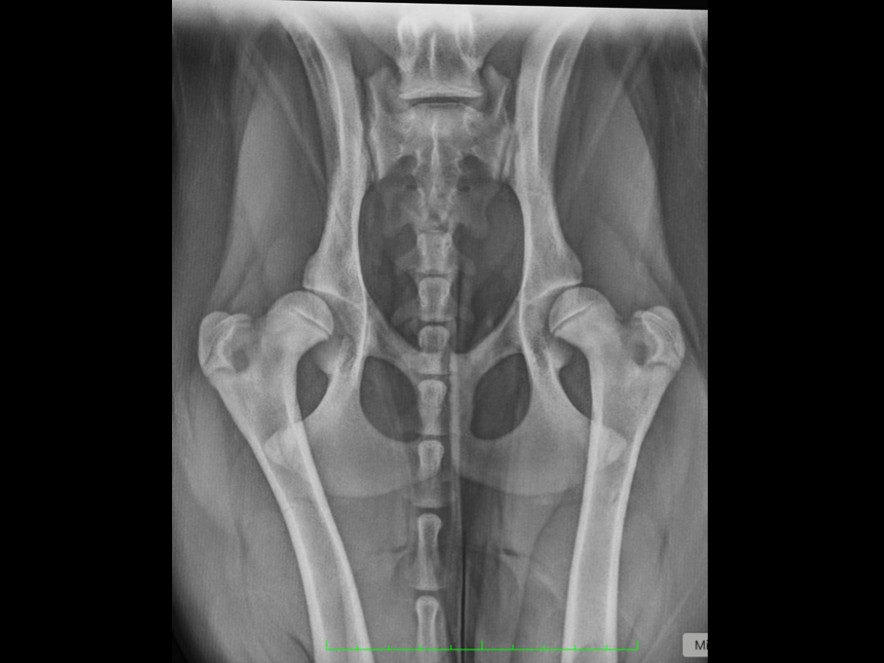
Total Hip Replacement (THR) is a treatment choice for dogs or cats with hip dysplasia, hip arthritis, hip fracture or a dislocated hip. It is the gold standard for achieving the best possible pain-free function in a diseased hip.
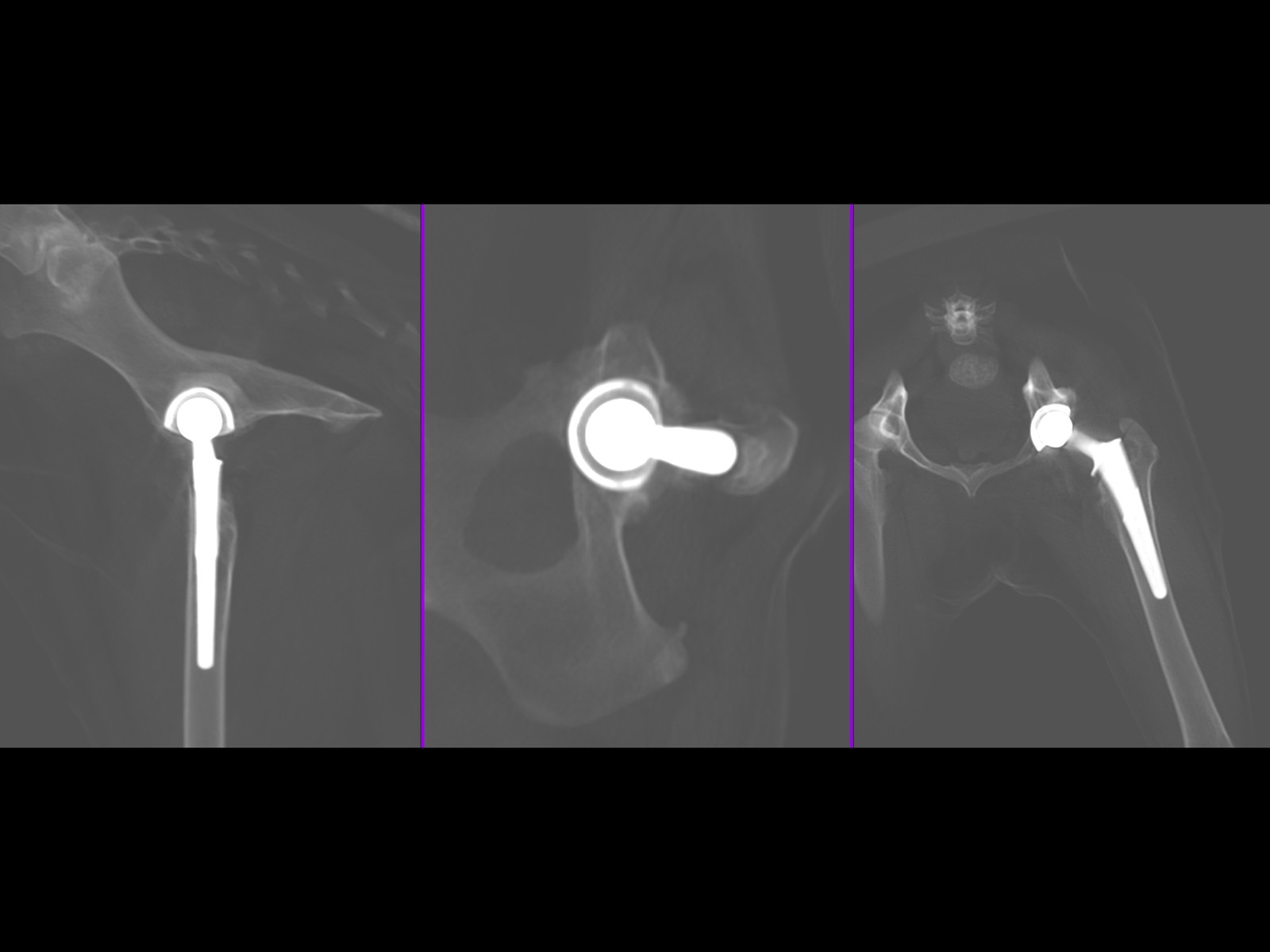
Total Hip Replacement (THR) is a treatment choice for dogs or cats with hip dysplasia, hip arthritis, hip fracture, or a dislocated hip.
The modular prosthetic hip replacement system used today has three components — the femoral stem, the femoral head, and the acetabular cup. The components are made of titanium, cobalt chrome and ultra-high molecular weight polyethylene. The hip replacement can be cemented, cementless, or half and half. We do a cementless hip replacement whenever possible to avoid problems with cement loosening longer term.
THR is the gold standard for achieving the best possible function and pain-free range of movement in a diseased / arthritic hip. The arthritic joint is replaced so the pain of bone rubbing on bone is gone, and the range of motion is improved to allow good joint flexibility.
If your dog has hip dysplasia, is over 9 months of age and has hip pain, then they are a potential candidate for a THR. A thorough examination to rule out other problems is a mandatory part of the preoperative examination. Surgery is recommended when hip pain and lameness are present and beyond mild in severity and/or the dog is not coping with conservative management, and/or you do not want to commit to many years of conservative management. Once the decision is made, the sooner the surgery is done the better; THR is somewhat easier in younger dogs with potentially a lower risk of complications.
Total hip replacement is not for everybody. Reasons not to do it include: if your dog is doing relatively well; if you cannot keep your dog rested and restricted post-operatively; if you cannot accept the risk of complications; for financial reasons; a dog that is very difficult to control in the post-operative period; or skin infection over the surgical site or uncontrolled infection elsewhere such as recurrent cystitis. Dogs that have already had previous hip surgery or femoral head and neck excision surgery are usually not such good candidates, as the surgery is more challenging and the chance of a complication is significantly higher.
Outcome is excellent, with a normal, pain-free hip range of movement and function expected. Most dogs walk on their new hip immediately after surgery with a moderate lameness, and a gradual return to normal function is allowed between 8 and 12 weeks after surgery. The majority of dogs have marked improvement in walking, sitting, climbing stairs, standing, running, getting into cars, playing and exercise; normal to near-normal function can be expected.
A success rate of 90 to 95% can be expected — i.e. 18 to 19 of 20 dogs have an excellent outcome with no problems, but 1 to 2 of 20 dogs may have a problem. Of that 10%, about half (5%) can be successfully corrected with further surgery, but the other half (5%) eventually require removal of the implants, i.e. abandoning the THR procedure and converting to a Femoral Head and Neck Excision Arthroplasty (FHNE).
The serious complication rate is approximately 5% or less. Hip replacement is one of the most technically demanding surgeries we perform and requires skill, accuracy and surgeon experience, as well as owner and patient compliance with post-operative restriction. When complications happen they are serious and carry additional cost. Possible complications include infection, hip dislocation, fracture, implant loosening (septic or aseptic), sciatic nerve damage, and severe bleeding.
The life of a THR in people is approximately 10–15 years. In animals, replacement of implants due to wear and tear has not been necessary — partly because dogs weigh less than people, their weight is distributed on four legs rather than two, and their average life span is considerably shorter. The THR should out-last the dog. Only one hip can be done at a time and the most painful hip should be replaced first; if pain is present on both sides, both should be replaced with an interval between surgeries, usually of at least 2–6 months. About 50% of dogs go on to have a second hip replacement, assuming both hips are affected similarly.
Clear recovery guidance so you know what to expect at every stage.
Restricted activity and rest. Pain management and wound care. Short lead walks for toileting only. Your pet will have a follow-up check at 2 weeks for suture removal.
Gradually increasing lead walks. Continued restricted activity at home. Physiotherapy exercises as advised by our team to support healing and muscle rebuilding.
Follow-up imaging to check bone healing. Gradual increase in exercise duration and intensity based on progress. Most dogs show significant improvement by this stage.
Return to controlled normal activity, case dependent. Off-lead exercise can usually be gradually reintroduced. Full recovery is typically achieved within 3–4 months.
Answers to common questions about this procedure.
Whether you're a vet looking to refer or a pet owner wanting to learn more, we'd love to hear from you.
Refer a Case →