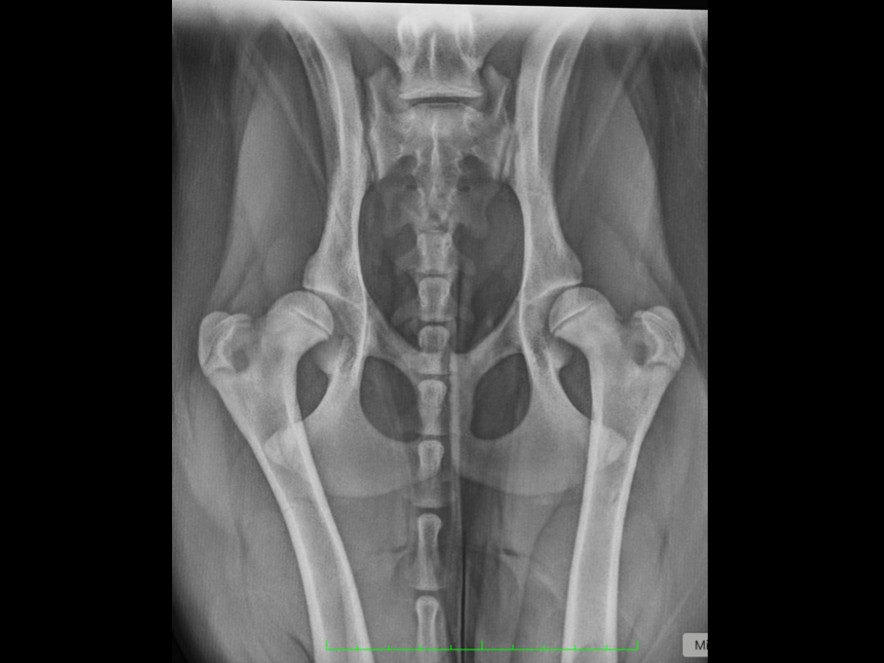
Femoral head and neck excision (FHNE / FHEA) removes the femoral head to relieve pain from a diseased hip. It is a relatively simple, inexpensive treatment option for painful hips where Total Hip Replacement is not chosen or possible.

Femoral head and neck excision (FHNE) — also called an excision arthroplasty, or femoral head osteotomy (FHO) — is a surgical procedure whereby part of the hip joint (the femoral head) is removed. It is a treatment option for painful hips. Removing the femoral head stops the painful moving / rubbing contact between the two bones of the hip joint and therefore improves lameness. A pseudoarthrosis, or false joint, forms in place of the original hip: the surrounding soft tissues (joint capsule and muscles) take over the role of stabilising the hip, which is less stable than a normal hip.
The aim of the procedure is pain relief and improving lameness.
Common conditions to consider FHNE surgery for include hip dysplasia, ischaemic necrosis (Legg Calve Perthes disease), chronic or irreducible hip luxations (dislocations), and hip fractures. The main reasons to choose FHEA surgery are:
We do not recommend FHEA surgery for mildly affected patients where there is a chance of making a mild lameness worse, or patients that are responding well to medication.
The advantages of FHEA surgery are that it is relatively simple and inexpensive, the possible complication list is very short with complications very rare and none serious, and post-operative management is relatively straightforward — although it is important to focus on intensive physiotherapy and hydrotherapy to regain the best possible hip function. It is said that cats and small dogs do better than bigger dogs, but the evidence for this is limited.
The disadvantages are that the joint is never normal, there is usually some permanent discomfort and restricted range of movement to full hip extension, and the results can be a bit variable and unpredictable. The outcome is not as good as with Total Hip Replacement surgery, which is the gold standard for best possible hip function; but patients can do well with FHEA surgery.
Clear recovery guidance so you know what to expect at every stage.
Restricted activity and rest. Pain management and wound care. Short lead walks for toileting only. Your pet will have a follow-up check at 2 weeks for suture removal.
Gradually increasing lead walks. Continued restricted activity at home. Physiotherapy exercises as advised by our team to support healing and muscle rebuilding.
Follow-up imaging to check bone healing. Gradual increase in exercise duration and intensity based on progress. Most dogs show significant improvement by this stage.
Return to controlled normal activity, case dependent. Off-lead exercise can usually be gradually reintroduced. Full recovery is typically achieved within 3–4 months.
Answers to common questions about this procedure.
Whether you're a vet looking to refer or a pet owner wanting to learn more, we'd love to hear from you.
Refer a Case →